
When I first tried to shape an interactive ASMR scene, I treated empty time as a mistake. If the gems settled and the sound stopped, I moved another one immediately. A new collision covered the previous decay; whenever the scene threatened to become quiet, I added motion. The waveform looked full and the screen never stopped sparkling, yet after a few minutes every impact sounded like one continuous texture. The surprise came when I dropped one gem, removed my hand, and waited for two seconds. I could hear a tiny tail, see the final rotation, and notice the exact moment the object became still. The time I had called empty was actually the end of the sound.
This article does not claim that silence heals the brain or that precisely two seconds increases an ASMR effect. Two seconds is only an easy interval to notice. The useful idea is that a sensory experience does not need equal stimulation in every moment. ASMR research has repeatedly shown variation among participants, and laboratory work has distinguished self-selected from standardized material. A trigger is not a universal button. If context and choice matter, then waiting, hearing a decay, and deciding whether to cause the next sound belong to the experience too.
Silence draws the boundary of a sound event
A gem contacting the floor begins with a short attack, continues through resonant vibration, and ends as both object and room decay. When another impact arrives too early, the first tail is masked. Instead of hearing where and how each gem landed, the listener may hear a continuous band of bright attacks. A short space makes it possible to follow the contour of one event. Quiet is not the absence of content; it is one way content finishes.
The same contrast exists visually. If every facet remains at maximum sparkle, no individual glint can become an event. A nearly still gem with slow reflections prepares the eye for the next change. Visual space does not require a black screen or a frozen application. It keeps subtle rotation and light while withholding a demand for new information.
Technical silence must be separated from designed space. If the sound control is on but no collision ever plays, the AudioContext remains locked, or a file fails to load, the product is broken. The space discussed here sits between sounds that have demonstrably played and ended. A listener must trust that the system works before quiet can feel intentional.
- Space lets the previous impact complete its decay.
- It restores a clear beginning to the next sound.
- Intentional spacing is different from a playback failure.
Change the shape of repetition before adding more randomness
The same sample at the same pitch, level, and interval quickly reveals a pattern. Large random changes are not a reliable cure. A weak collision paired with a suddenly loud recording or a tiny gem producing an implausibly low ring breaks cause and effect. Sound selection should first respect impact strength, location, and object scale. Small pitch and gain variation can then live inside that relationship. Sometimes the least expensive and most convincing variation is choosing not to play another sound immediately.
This does not mean inserting silence every two seconds like a metronome. Regular silence becomes another obvious loop. A large impact can be given more time to decay, rolling contacts can use smaller gaps, and a naturally busy pile can briefly remain busy. Density should vary for a physical reason. In manual play, the hand stopping already creates the most legible form of space.
Barratt and Davis’s early ASMR survey recorded a broad set of reported triggers, including whispering, personal attention, crisp sounds, and slow movements. It did not establish one interval that works for everybody. The diversity supports a more modest design conclusion: the listener should be able to change event density. A rich cluster may suit one person or one evening; a single impact and a long tail may suit another.
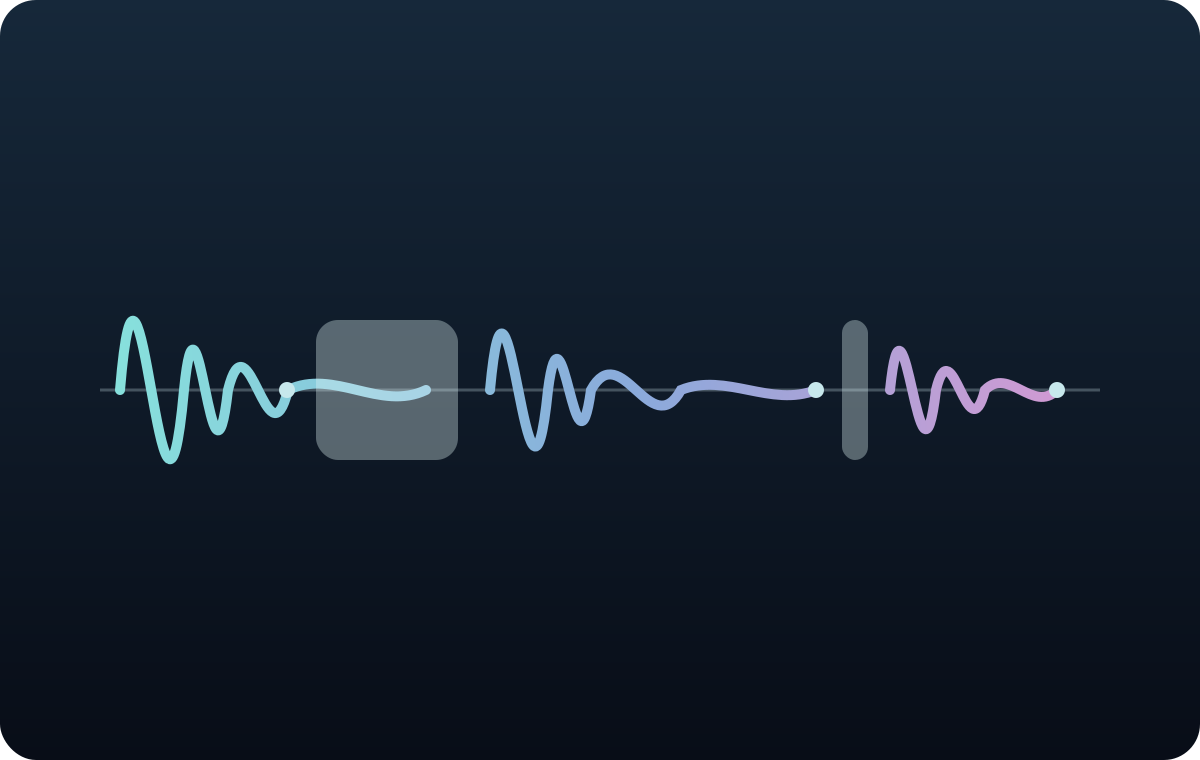
There are three spaces: before, between, and after
The first space comes before playback. Dropping the maximum gem count as soon as a page opens gives no time to check level or understand the scene. Starting with one visible gem lets the first click or touch unlock audio and act as a clear opening gesture. The listener can anticipate the initial sound and lower the device before the complex moments arrive.
The second space sits between events. Move a gem, release it, and wait until the ring has nearly faded. Small rotation and reflection remain on screen, so this need not feel like dead time. The third comes after the final impact. Instead of jumping directly into another clip, mute the scene briefly and allow the room to return. That moment creates a boundary between the session and the next activity.
None of these gaps must be long. Five seconds before starting, half a second to several seconds between events, and one uncounted breath at the end may be enough. If counting becomes tense, abandon the number and wait until the decay is nearly gone. Space is not a performance task and calmness is not a score.
A twelve-minute comparison for finding your own spacing
For four minutes, use three gems in your normal style. Remember one welcome moment and one tiring moment without judging either. For the next four, move once and remove your hand until the decay is almost gone. During the last four, mix the approaches: gather several gems only when you want abundance and return to one when you want definition. Keep master volume stable so interval, rather than loudness, remains the main change.
Afterward, ask more than whether a tingle occurred. Note when you did not feel rushed to act, when position was easiest to hear, and when you wanted to raise volume. A useful note is specific: ‘three seconds after a large impact felt good,’ ‘continuous rolling was fine,’ or ‘above ten gems the high sounds merged.’ It is not a rule for another person. It is a starting point for the next visit.
Do not repeat the experiment daily in pursuit of a perfect value. Once logging becomes an obligation, ASMR has turned into another management task. Revisit it after changing headphones, making a large gem-count change, or encountering an unusually tiring session. Different results do not mean failure; they are evidence that the conditions changed.
- Four minutes: observe your usual interaction.
- Four minutes: wait for the decay after each gesture.
- Four minutes: choose richness or space as needed.
- One sentence: record a welcome interval and a stopping point.
Do not force silence on someone who finds it uncomfortable
Quiet can make tinnitus or environmental sounds more noticeable, and some people feel more anxious or isolated when audio disappears. Complete silence should not become an ideal imposed on every listener. Low ambient sound, distant soft rolling, or visual motion without sharp impacts can provide a middle ground. An accessibility rule fails when it ignores the person it is supposed to support.
Some people do not experience ASMR tingles at all. In Poerio and colleagues’ work, pleasant responses were more evident in the group identifying as ASMR experiencers; not every participant had the same reaction. There is no need to compensate for absent tingles with faster, stronger stimulation. Enjoying the physics, light, and brief play is enough reason to use the site. Disliking the sound is also a valid reason to mute it and keep only the visual experience.
Ear fullness, pain, sudden ringing, or changed hearing should not be treated as a spacing puzzle. Stop playback and seek appropriate guidance. Persistent anxiety or sleep difficulty that disrupts daily life should likewise not be managed as though ASMR were treatment. This article suggests a listening practice, not diagnosis or care.

The simplest way to make space in Gem ASMR
Open the Playground and leave one gem. Move it slowly from the edge toward the center, release it, and remove your hand until the tail is almost gone. Then drop the same gem from a lower height and listen for how the decay changes rather than asking which impact is louder. Finally, bring two gems together lightly and separate them. These three gestures are enough to reveal gem contact, floor contact, and the space following each.
If you want more pieces, add two or three at a time rather than ten. When the sound becomes one bright mass, remove a piece. Gather is an invitation to reorganize the scene, not an instruction to shake it hard. Leaving the pile alone and hearing the last tiny contacts settle is also play. Rotate the camera without moving gems when you want to separate visual change from sound change.
At the end, use mute and watch the scene for about five seconds. Nothing special has to happen. Turn sound on if you consciously want another passage, or close the page if you have had enough. Designed space is not a trick for manufacturing a deeper response. Its purpose is to keep the next sound, the number of gems, and the ending in the listener’s hands. That is where interactive ASMR differs most usefully from an endless recording.