You try to take a thin slice off a crystal fruit. The first piece looks right. The second is thicker, so you draw another line. That one comes out at an awkward angle. After a few more attempts, you might realise you cannot remember a single sound from the last several cuts. You opened a listening experience and somehow ended up correcting a picture.
There is nothing wrong with wanting tidy pieces. On some days, arranging a pleasing result is the whole attraction. But in Gem ASMR, a neat cut and an enjoyable sound are separate things. They do not have to succeed together. An uneven piece can still be part of a moment worth hearing.
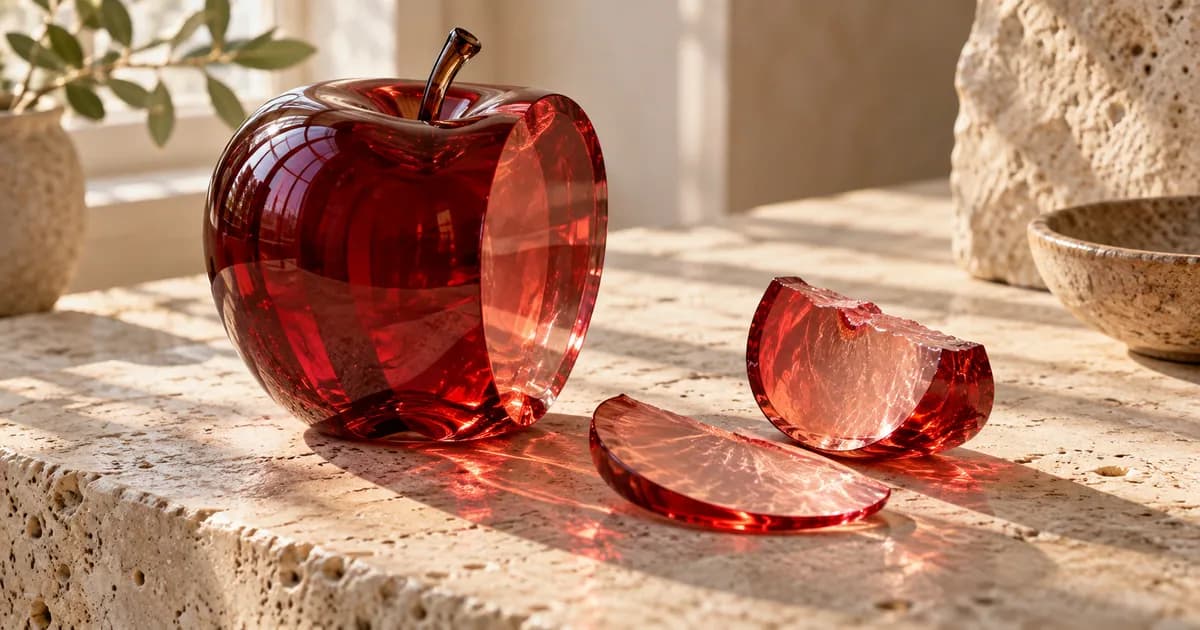
The image is an AI-created editorial illustration, not a gameplay screenshot or a photograph.
When you are looking past the current cut
Once you have a finished scene in mind, every piece starts looking unfinished. The other side needs matching. That sloping edge needs another pass. Meanwhile, the friction during the stroke and the small sounds after separation become background noise. The object is responding now, but your attention is already with a shape that does not exist yet. You do not need to ban that kind of play; it is simply useful to notice when it has taken over.
Try giving the next stroke a smaller job. Instead of dividing the object symmetrically, listen for the difference between the sound that continues during the gesture and the sound when the cut finishes. Leave the result alone for a moment, even if it lands awkwardly. You may find yourself thinking that it looked rather messy but sounded good. That is a perfectly usable description, not a consolation prize for getting the shape wrong.
Change one line, not everything at once
Open Gem Cutting and cut the current object once. Reset pieces lets you return to that target; New Gem gives you a different one. Use the first when you want to explore another angle on a familiar shape, and the second when the shape itself no longer interests you. There is no need to keep generating new objects just because one cut did not look the way you imagined.
Keep the volume steady while you compare. A different angle, a louder setting and a new target all at once make it difficult to say what you actually liked. Try a longer stroke, then a shorter one, or let a similar stroke travel less hurriedly. This is a listening suggestion rather than a controlled experiment. If a cut does not register, check whether the gesture crossed the object rather than empty space. Enjoying an imperfect result is not the same as accepting broken input. Repeated problems are worth reporting with your device, browser and the steps that reproduce them.
The part a screenshot leaves out
A still image preserves the arrangement but loses the time it took to get there. A small irregular piece might have made the sound you enjoyed most. Or the longer passage through a large section might have been the attraction. Neither preference has to win a competition for the most sophisticated taste. A striking finished image and an enjoyable movement can overlap, but one is not a reliable score for the other.
There is also a limit to what research can tell us here. Poerio and colleagues' 2018 study examined responses to ASMR videos; it did not test a relaxing cutting angle in Gem ASMR. The ideas in this article are things to try in the product, not a clinically established routine. If careful, symmetrical cutting is what you enjoy, keep doing it. Being told to stop caring about the result could spoil that pleasure. You can choose precision, surprise or simply following the sound, and choose differently next time.

The remaining pieces are not unfinished homework
A few large pieces left on screen can look like work still waiting to be done. They are not an assignment. One satisfying cut can be enough. You can leave half a fruit, move to another mode, or close the page. Cutting more is not proof that you listened better. If drawing lines has become a chore, the Playground offers a different activity: moving gems and hearing them meet. That is an option, not an instruction to keep browsing until you find a perfect mood.
Do not turn up the volume just to recover a tiny sound you missed. WHO's safe-listening guidance recommends keeping volume down and taking breaks from loud sound. A beautiful cut is not a reason to stay with audio that feels uncomfortable. Before choosing the next object, remember one thing you liked: the thin piece, the sustained stroke, or perhaps neither. Learning a little about your preference can be a better reason to return than finally producing a flawless arrangement.